
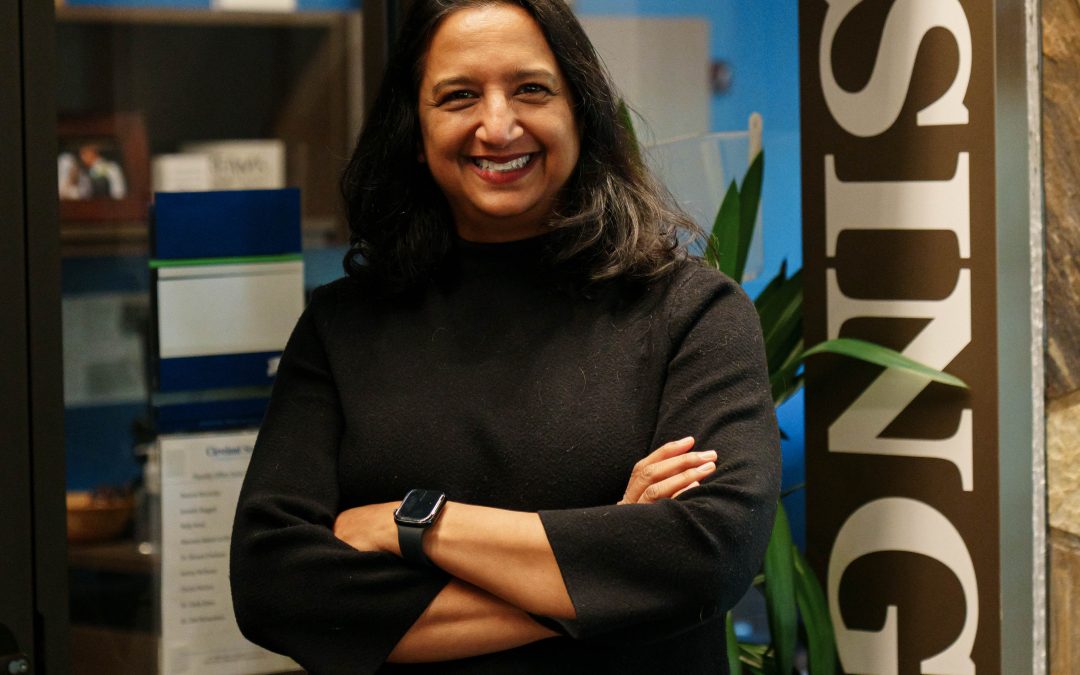
Maureen Baksh-Griffin, Director of Nursing at Cleveland State Community College, expected to be a Christian missionary in a foreign land. Instead, her calling led her to a career in nursing, disaster response and education, where she continues to make a difference by preparing others to care for their communities.
“My parents were both raised by missionaries in Pakistan (post the British partition of India),” Baksh-Griffin said. “My father was raised by Presbyterian missionaries, and my mother was raised by Seventh-day Adventist missionaries. Growing up I remember my church having Mission Spotlights where I saw missionaries share love and practical sustainable support in amazing places like the jungles of Borneo and the Amazon. At six, I thought I would do that.”
Fluent in six languages, Baksh-Griffin later thought she would coordinate a strike team of nurses to travel the world providing disaster relief. Today, she sees an opportunity to make a greater impact by training future nurses at Cleveland State.
“I can help shape and influence the minds of many more individuals who will be the hands and feet of service to provide care for others,” Baksh-Griffin said. “Here at Cleveland State, we create that opportunity for students, and each graduating class goes out and cares for more people than I would have been able to on my own. It is a force multiplier.”
Born and raised in New York City, Baksh-Griffin graduated from The Bronx High School of Science and earned a Bachelor of Arts in Human Communication from the City University of New York (CUNY) Hunter College in Manhattan. After traveling through Europe and the South Pacific and working as a corporate reorganization/bankruptcy senior legal assistant for a New York law firm, she began considering a different career path. Through prayer and reflection, she discovered nursing.
While continuing to work, she completed the prerequisites for nursing school and then earned a Bachelor of Science in Nursing from New York University (NYU) in 1999 when she began working as a medical-surgical nurse at NYU Medical Center.
In 2001, her life changed dramatically when she lost her brother, Michael, in the terrorist attacks on 9/11. He was at work in a new job at the World Trade Center on one of the impact zone floors of the first plane strike in the North Tower.
“The shock of all of it left little time to process the event as it unfolded, and it was challenging to provide care for others when taking care of your own pain and dealing with loss,” Baksh-Griffin said. “It was his first day of work. Who knows or considers the exit route on the 94th floor on your first day of work? That event changed the trajectory of how I thought about nursing.”
After six years of medical-surgical nursing, Baksh-Griffin decided to change specialties and move to emergency nursing at Columbia University Medical Center. She began exploring graduate programs and learned about a new BSN-PhD program at the University of Tennessee, Knoxville. She was accepted and relocated to Tennessee with her two sons in 2009. She earned a Master of Global Disaster Nursing in 2012 while working at Erlanger Hospital in Chattanooga.
Her path to Cleveland State began through a connection with Nancy Thomas, a Cleveland State nursing faculty member who was also enrolled in the graduate program. Thomas recruited Baksh-Griffin to teach in Cleveland State’s first evening nursing cohort, which began in January 2012.
At Cleveland State, Baksh-Griffin brought her disaster preparedness expertise to the classroom by participating in the organization of the college’s annual Mass Casualty/Disaster Simulation event. In the multidisciplinary exercise, students and local emergency services practice responding to emergency/disaster scenarios.
“I’ve applied disaster preparedness training principles to education and leadership,” Baksh-Griffin said. “Our simulation was a great fit with what I was already doing, and I wanted to develop something that was sustainable. I am grateful because it is now deeply embedded in our curriculum. Even though I currently do not do disaster preparedness in the same capacity anymore, it’s something that our students are exposed to and can take with them.”
Baksh-Griffin has been able to serve at the state level with the TN Department of Health. From 2020 to 2022, she was a Covid Strike Team Coordinator, working with the southeast region’s ten county health departments. She has also participated in the TN Board of Regents (TBR) Maxine Smith Fellowship and represents Cleveland State on the TBR Faculty Sub-council, which serves as a liaison between campus faculty from the thirteen state community colleges and the Board of Regents.
With a nursing shortage and a continuing need for nursing faculty, Baksh-Griffin takes pride in Cleveland State’s nursing program and the opportunities it creates for students.
“I see our graduates in the community; they are here, and they provide care for their neighbors, families and friends,” she said. “That is a beautiful thing to watch; to see and recognize the trajectory of their lives changing. For many first-generation attendees, for many adult students returning who never got a chance to finish, I see this as the most active form of creating opportunities for individuals.”
Although she once imagined serving in a conflict zone or on a humanitarian response team, Baksh-Griffin has found purpose through her work at Cleveland State, transforming students’ lives while preparing them to make a difference in the lives of others. She said, “I didn’t think I would be here as the Director of Nursing, but I pray, ‘Whatever my gifts and talents are, Lord, wherever you need them, I will go. Whatever you need me to do, I will do it.’”